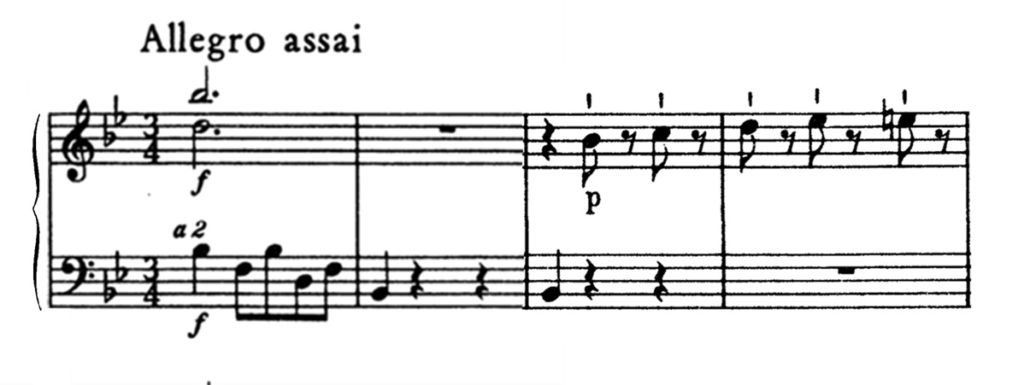
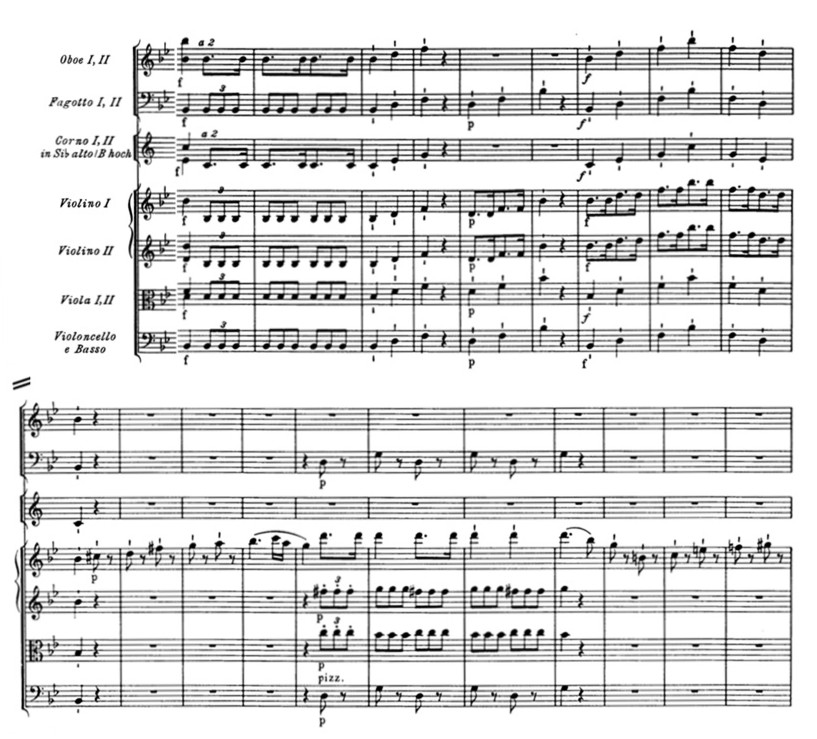
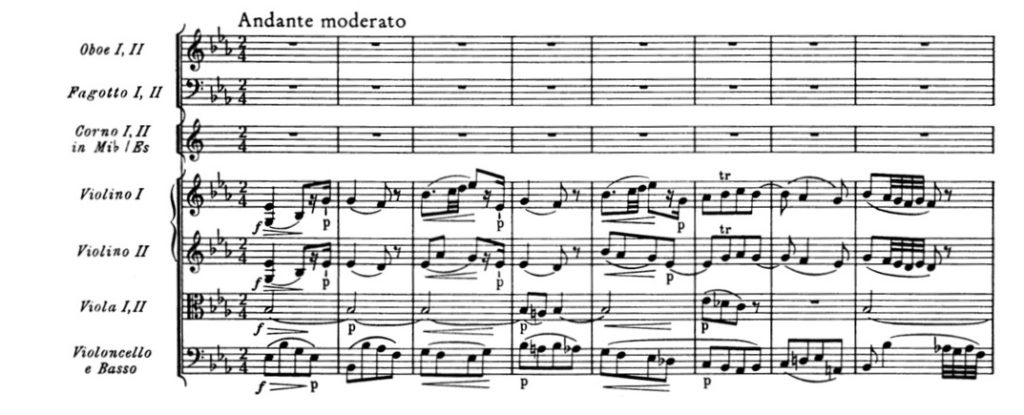
Some months later, at the beginning of July 1779, Mozart in the symphony in B flat; draws for us a delightful picture of a beautiful summer’s day;
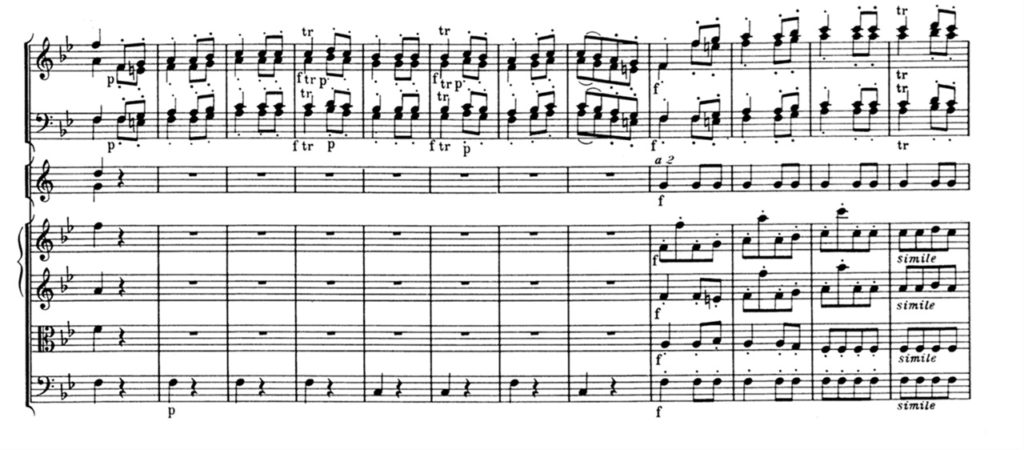
we could almost describe it as his ‘pastral’ symphony. It is full of gust, joy, dancing, not unmixed with a certain ecstasy (in the first movement) , expressed by numerous and insistent chromaticism.
Like so many first movementin 3/4, this one, too, is preponderately rhythmic in quality; an unbroken pulsing dynamism; with a flowing quaver movement as basic rhythm. sometime alone, sometime interplaying with themes and motives of stronger substances, but when they are absent one feels that they are only suspended, not completely dropped.
In the finale, when Mozart gives free rein to his humour, the main feature is again its rhythm, basically the movement is a stylized gigue. The principal subject may suggest Beethoven’s Eighth Symphony, but the two other prominent themes, the naively clever second subject and the closing themes first introduced by woodwind alone are so stamped with the buffa spirit ………… in due course, with a unison passage we reach the recapitulation which again return to the previous buffo effect.
The final movement gives unbridled expression to a very real sense of delight in existence, the main vehicle of this delight being an effervescent and fiery triplet motif that darts through the whole of orchestra, appearing now as the main idea, now as a mere accompaniment. The movement as a shole resembles nothing so much as a delightfully animated funfair attended by the most varied types, from nobility to commoners.